
Polyurethane PUR
Polyurethane (PUR) is our specialty
UW-ELAST designs, develops, and manufactures polyurethane products. We assist you from idea to delivery and application; challenge us because solid polyurethane elastomer is an ideal construction material.
Why use polyurethane?
- Resistant to mechanical abrasion
- Good load-bearing capacity and low compression set
- Polyurethane withstands continuous working temperatures between approximately -40°C to approx. +80°C
- Good resistance to water and resistance to oil, gasoline, and other similar liquids
- Very strong adhesion to other materials such as metal, plastic, and similar
- Has a sound-dampening effect and often lines scrap transports and equipment with similar exposure

What is polyurethane?

Polyurethane, PUR, is a collective name for a large number of materials with varying properties. What they have in common is that they contain urethane groups (-NH COO-). A large number of other chemical groups, such as ester, ether, urea, biuret, allophanate groups, and double bonds, can be included in the polyurethane molecules.
By mixing in pigments, fillers, fibers, various additives, and other polymers, the properties can be varied practically without limit. There is no other material group that offers the designer such great possibilities as polyurethane (PUR).
Polyurethanes can be soft or hard, solid or cellular, high-damping or low-damping, brittle or impact-resistant, and have high or low water absorption.
Polyurethanes exist in various forms
Polyurethanes are available as rubber, thermoplastics, thermoelasts, thermosets, cellular plastics, fibers, foils, rocket fuels, and as binders for paints, lacquers, and adhesives.
Depending on the structure, polyurethanes can be processed in different ways. They can be reaction-molded using high-pressure or low-pressure machines, injection-molded, extruded, pressed, and foamed using several methods.

Own brands within polymeric materials
UW-ELAST har valt att arbeta med egna varumärken eftersom det inte finns någon standard för polymera material på samma sätt för exempelvis stål. These include, for example, Slitan, Trekollan, and Vulkollan, as well as to some extent TPU, which is a thermoplastic polyurethane.
One designation is Solid polyurethane, which is a superb construction material where properties can be varied almost infinitely. That is the challenge, and that is where we come into the picture. UW-ELAST has very long experience in this, since 1975.
UW-ELAST has knowledge of the material and can make adaptations for every application, so when a problem or question arises, contact us for a discussion to find the optimal technical solution.

Slitan
Slitan is particularly suitable for industrial applications such as heavy industry and the engineering industry. It can be used to manufacture structural components and to coat rollers and wheels, providing very high wear resistance.

Trekollan
Trekollan is very suitable for applications involving abrasion, such as plow blades and concrete mixer linings.

Vulkollan
Vulkollan is what is known as the “King of Urethanes.” It is suitable for coating wheels and, to some extent, rollers where there are extremely high dynamic loads. A good example of this is the Lisebergbanan roller coaster, where we have coated the wheels with Vulkollan.
Material knowledge “polyurethane”
Milling and turning
- Use sharp, file-sharpened tool edges.
- High cutting speed.
- Slow feed rate.
- Greater clearance than for metals.
- Milling is difficult below 50 Shore A.
- Cooling is recommended
Drilling
- Use twist drills.
- Sharp edges.
- Clearance angle 0 or negative.
- Point angle 90–110 for large diameters and/or thick-walled parts, 115–130 for thin-walled parts.
- Slow feed (approx. 0.2 mm/rev).
- High speed.
- Cooling with cutting oil.
Drilling and punching
The drill should be retracted occasionally to prevent chips from blocking the hole. If a series of small holes is to be drilled, pins should be inserted into the finished holes; otherwise, the material “flows” into them and the new holes will not be round. Polyurethane is elastic and springs back. The hole will therefore be about 4% smaller than the drill bit. For making holes in thin sheets, punching can also be used. For this purpose, sharp hollow punches mounted in a press are used. Generally, holes larger than the thickness of the polyurethane are difficult to punch. In reality, it is the strength of the punching tool that is the limitation. When punching thick sheets, the hole becomes “hourglass-shaped.”
Splitting
A variety of methods exist for manufacturing thin sheets from thicker ones. Using so-called splitting machines, the most important part of which is a sharp knife, it is possible to manufacture very thin foils from a polyurethane cylinder. Thick sheets can also be sawn with a standard band saw. The material should then be cooled with a coolant.
Read more about polyurethane sheets here.
Bonding of polyurethane
It is easiest to achieve good adhesion if the polyurethane is not fully cured. If the polyurethane is fully cured, the surface must be roughened or blasted with steel grit. The surface must then be made very clean from dirt and release agents. A major problem is silicone oil-based release agents, which are difficult to remove completely.
For bonding polyurethanes, polyurethane adhesives or fairly flexible epoxy adhesives are best suited. The adhesive should provide a joint that has lower stiffness than the polyurethane; otherwise, there is a risk of the joint breaking under bending loads.
Epoxy resins, polyurethanes, and silicone rubber are mainly used as potting compounds for electrical and electronic components. Each material group has its advantages and limitations.
Silicone rubber
Silicone rubber has superior temperature resistance and, at the same time, the best low-temperature properties. Furthermore, silicone rubber has a very low dielectric constant and a very low dielectric loss factor. This means that silicone rubber is not heated by, for example, microwaves. In the event of a fire, only a small amount of toxic gases is developed, and the ash, which consists of silicon dioxide, is electrically insulating, in contrast to the ash from polyurethane and epoxy.
Limitations for silicone rubber include a very high price, high water permeability, and relatively poor mechanical properties compared to epoxy and polyurethanes. The latter, however, does not always have to be a disadvantage; for example, it can facilitate the repair of encapsulated components.
Polyurethane and epoxy
The materials that compete most closely with each other are polyurethane and epoxy. Both have their advantages and limitations; which material is best depends entirely on the application.
Compared to epoxy, however, polyurethane has the following advantages:
- Greater range of variations.
- Lower heat generation during curing.
- Lower shrinkage during curing, resulting in lower shrinkage voltages.
- On average, better dielectric strength.
- Shorter curing time.
Epoxy, however, has lower water absorption, higher volume resistivity, and a lower dielectric constant than polyurethanes.
Important electrical properties
Important electrical properties include volume and surface resistivity, dielectric constant, dielectric strength, dielectric loss factor, arc resistance, and tracking resistance.
Other important properties for potting compounds include low flammability, insulation capacity after fire, water vapor permeability, corona resistance, ozone resistance, moisture absorption, aging resistance, and good mechanical properties. Self-extinguishing polyurethanes corresponding to UL 94 V0 can be obtained by mixing, for example, aluminum trihydrate into the casting compound.
Like mechanical properties, electrical properties change more or less with the surrounding environment, frequency, and aging.
Under compressive load, rubber behaves like an incompressible liquid – when rubber is compressed, the shape changes but not the volume. In contrast to a liquid, however, rubber returns more or less to its original shape. These properties and the design of the rubber component affect how much it is compressed at a certain load. The fact that rubber is not compressible must be taken into account during design. Solid rubber must always have the possibility to bulge out under compressive load and must absolutely not be enclosed.
Compressive load and tensile load
Rubber is mostly used under compressive loads, and most types of rubber, apart from urethane rubber, silicone rubber, and EPDM rubber, have a significantly shorter lifespan under tensile load than under compressive load. How the rubber behaves under compressive load is of great importance for its function. An important property is how much the rubber deforms at a certain load. A certain deformation may be desirable, e.g., when using rubber for vibration dampers.
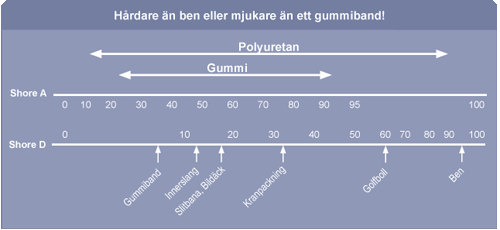
Polyurethanes can be made ranging from very soft to hard and therefore bridge the gap between rubber and plastics.
By, for example, foaming the polyurethanes, microcellular polyurethane made from harder base materials can replace conventional softer rubber and provide the same elastic resilience and strength.
One advantage is that, unlike rubber, microcellular polyurethane is compressible, i.e., its volume decreases under compressive load. The figure above shows the relationship between polyurethane and rubber, as well as comparisons with other materials to illustrate the possibilities of polyurethane.
Abrasion resistance of different materials.
| Relative abrasion resistance | |
|---|---|
| Styrene plastic | approx. 30 |
| Polyamide 66 | approx. 6 |
| HDPE | approx. 19 |
| PTFE | approx. 5 |
| Epoxy plastic | approx. 16 |
| Polyurethane | approx. 0.5-0.8 |
| Rubber | approx. 0.6-1.9 |
| Aluminum | approx. 5 |
| Steel (high-strength) | approx. 0.5-0.7 |
| Wrought iron | approx. 1 |
Tear strength generally increases with increasing hardness
This is particularly marked for ether urethanes, and with the choice of a suitable polyol and high hardness, they become almost as tear-resistant as polyester urethanes. In this case as well, the increasing number of hydrogen bonds in the polyurethanes is a contributing factor. However, the tear strength for both polyether urethanes and polyester urethanes can vary greatly at the same hardness. For example, polyether urethanes based on propylene glycol have significantly lower tear strength than those based on polytetramethylene glycol.
The effect of temperature on tear strength.
More or less all polymeric materials experience decreased tear strength with increasing temperature. At room temperature, polyurethanes have significantly better tear strength than natural rubber. At approx. 100 degrees, standard cast polyurethanes and natural rubber have roughly the same tear strength, and above 100 degrees, natural rubber may even have better tear strength. However, there are both cast and vulcanizable polyurethanes that have better temperature properties than the standard types. The tear strength of thermoplastic polyurethanes is even more sensitive to temperature increases than that of cast types. Exceptions include those that are cross-linked by irradiation after injection molding. Tear strength also decreases with aging.
Figure 14. Relative tear strength for some materials as a function of temperature.
A = Polyester urethane
B = Natural rubber
C = Chloroprene rubber
D = Nitrile rubber
The high shear strength of polyurethanes combined with compressive load capacity makes the material interesting for applications such as punching and shape cutting of sheet metal blanks, by using steel rules working against a polyurethane punching base. This involves relatively simple and inexpensive tools for punching sheet metal parts in small and medium-sized series.
Polyurethanes can be formulated to achieve high impact resistance even at very low temperatures. However, there are significant differences between various polyurethanes. Polyurethanes stiffen earlier during cooling than natural rubber, for example. Common polyester urethanes may have stiffened considerably already at -20°C. A certain degree of stiffening may remain upon warming. This makes such materials less suitable for use in seals intended for low-temperature applications.
However, it is possible to produce polyurethanes that do not stiffen as rapidly during cooling. Examples of these include diphenylmethane diisocyanate-based poly-ε-caprolactone urethanes and polyether urethanes. While they stiffen faster than natural rubber during cooling, they do so less rapidly than chloroprene rubber. Despite the increase in stiffness, polyurethanes do not become brittle until very low temperatures are reached, as shown in the table.
The low brittle point means that soft polyurethanes can hardly be broken at temperatures above approx. -50°C. At approx. -50°C, even the harder polyurethanes (>70 Shore A) have the same impact strength as acetal plastics and significantly better impact strength than polyamide 6 and polyamide 66. At room temperature, hard polyurethanes can have up to 5–8 times higher impact strength than polyamide 66 and polyamide 6, and approx. 10 times better impact strength than acetal plastics.
However, it depends on how the polyurethanes are structured. It is possible to make polyurethanes that have very high impact strength or those that have very low impact strength.
| Elastomer type | Hardness Shore A | Brittle point |
|---|---|---|
| Natural rubber | 71 | -56 |
| SBR rubber | 72 | -50 |
| Chloroprene rubber | 62 | -42 |
| Polyethylene adipate urethane | 80 | -50 |
| Adiprene L100 | 88 | < -62 |
| Poly-ε-caprolactone urethane | 60 | < -75 |
Under compressive load, rubber behaves like an incompressible liquid – when rubber is compressed, the shape changes but not the volume. In contrast to a liquid, however, rubber returns more or less to its original shape. These properties and the design of the rubber component affect how much it is compressed at a certain load. The fact that rubber is not compressible must be taken into account during design. Solid rubber must always have the possibility to bulge out under compressive load and must absolutely not be enclosed.
Compressive load and tensile load
Rubber is mostly used under compressive loads, and most types of rubber, apart from urethane rubber, silicone rubber, and EPDM rubber, have a significantly shorter lifespan under tensile load than under compressive load. How the rubber behaves under compressive load is of great importance for its function. An important property is how much the rubber deforms at a certain load. A certain deformation may be desirable, e.g., when using rubber for vibration dampers.
Polyurethanes have approx. 10–21 times greater thermal expansion coefficient than steel. This must be taken into account during design, so that space is provided for the polyurethane material to expand when heated.
Mold shrinkage
The majority of mold shrinkage is due to the thermal expansion coefficient and only to a small extent to chemical contraction. Linear mold shrinkage for cast urethane systems lies between approx. 1.4–2.2% depending on, among other things, composition and reaction temperature.
However, in certain critical cases (complex moulds), the slight chemical contraction may cause internal cracks before the material has reached sufficient strength.
By lowering the mixing temperature and the mould temperature by approximately 6–9°C and increasing the oven temperature by 6–9°C, the urethane rubber can instead be made to expand slightly, thereby preventing the formation of internal cracks.
Mould shrinkage also depends on wall thickness and hardness. For injection-moulded thermoplastic polyurethane, mould shrinkage is also highly dependent on the injection pressure. In addition, post-conditioning has an effect (applies to all polyurethanes).
Mould shrinkage must be given particular consideration when polyurethane is combined with metals or ceramics.
Like everything else, urethane elastomers age. Aging is caused by, among other things, water, heat, light, oxygen, chemicals, fatigue, microorganisms, mechanical attacks, etc. Aging types can be divided into purely mechanical aging (e.g., fatigue), thermal degradation, thermo-oxidative degradation, photo-oxidative degradation, radiolysis, acidolysis, hydrolysis, microbiological attacks, etc. Most often, it is a combination of several degradation mechanisms. One of the most common causes of severe degradation of certain polyurethanes is hydrolysis, which is caused by water and heat together (Hydrolysis is Greek and is formed from hydro = water and lysis = decomposition).
It is possible to achieve very tight tolerances through extremely precise moulding tools and specialised machining.
However, it is important to bear in mind that the tighter the tolerance, the higher the cost. You should therefore avoid setting tight tolerances unnecessarily.
Always consult us regarding the desired function so that we can offer the most cost-effective solution.
Dimensional accuracy for polyurethane differs from that of metal in two main respects:
- Elasticity
Polyurethane can deform 100 times more than metal under normal loads. - Thermal expansion
As polyurethane has a thermal expansion coefficient 10 times higher than that of metal, its dimensions are highly dependent on temperature.
A component measuring 1000 mm at room temperature will measure 1010 mm at +60°C.
UW-ELAST applies Standard SS-ISO 3302-1 for dimensional tolerances.
Adiprene
Uniroyal’s trade name for polyurethane based on toluene diisocyanate and polyether glycols.
Allophanate groups
Formed by the reaction between isocyanate groups and urethane groups.
Amines
Ammonia derivatives where one or more hydrogen atoms in ammonia have been replaced by carbon-containing radicals. Amines are used, among other things, as chain extenders (curatives) and catalysts in the manufacture of polyurethanes.
Aliphatics
Acyclic compounds in which the carbon atoms are bonded to each other in open, straight, or branched chains.
Aliphatic isocyanates
Isocyanates based on aliphatic compounds.
Aromatics
Homocyclic compounds with six carbon atoms in the ring, which are unsaturated. Aromatics can consist of several such rings. The simplest aromatic compound is benzene.
Aromatic isocyanates
Isocyanates based on aromatic compounds. They are cheaper than aliphatic ones but discolor upon aging.
Antioxidants
Chemical compounds that are sometimes added to prevent oxidation of, among other things, polyurethane.
Elongation at break
The elongation when the specimen breaks under load.
Pot life
The time during which a mixture of prepolymer and chain extender is castable.
Butanediol
Difunctional alcohol, which is used, among other things, as a chain extender in the manufacture of polyurethanes.
Castomer
Baxenden Chemicals’ trade name for a series of urethane prepolymers.
Hydrogen cyanide
Highly toxic. Can be formed when heating polyurethanes and isocyanates.
Diisocyanates
Contains two isocyanate groups (see isocyanate). O=C=N-R-N=C=O.
Tensile strength at break
The highest tensile stress a material can withstand before it breaks.
Elastomers or elasts
Collective name for rubber and thermoelasts. According to ISO 1382: “polymeric material that quickly returns to almost original dimensions and shape upon unloading after having been subjected to severe deformation by the action of low mechanical stress.”
Modulus of elasticity
E-modulus, Young’s modulus gives the relationship between stress (σ) and strain (ε). For practical use, steel follows Hooke’s law E=σ/ε. Polymeric materials follow Hooke’s law only at very low strains.
Elasticity
The ability of molecular chains to return to their original position when the load ceases.
Ester groups (-COOR)-
Occur in polyester urethanes. Provide good mechanical properties but can impair hydrolysis resistance.
Ether groups -O-
Provide good hydrolysis resistance in polyurethane systems, but particularly soft polyurethanes have lower mechanical properties than corresponding polyester urethanes.
“Green strength”
Refers to the strength at the time of demolding.
Rubber
Elast that is cross-linked or can be cross-linked so that it is practically insoluble (but can swell) in boiling solvents such as benzene and methyl ethyl ketone.
Hydrophilic
Opposite of hydrophobic.
Hydrophobic
Water-repellent
Hydrolysis
From the Greek hydro=water, lysis=decomposition. Certain polyester urethanes are easily hydrolyzed by hot water or steam.
Hydrolysis stabilizer
Carbodiimides added to polyester urethanes to delay hydrolytic degradation.
Hydroxyl
Reactive group -OH
Curative
Chain extender used to cure prepolymers into polyurethane. Multifunctional amines and glycols are used as curatives.
Hardness
The ability of the surface to resist penetration. For polyurethanes, it is most often measured in Shore A or D. There is a certain relationship between E-modulus and hardness.
Isocyanates
Reactive groups – N=C=O, which react with, among others, hydroxyl groups (-OH) to form urethanes and with amine groups (NH2) to form urea (carbamide).
Blowing agent
Used in the manufacture of cellular plastics. Blowing agents for polyurethanes include hydrofluorocarbons, hydrochlorofluorocarbons, and carbon dioxide (formed by the reaction between isocyanate and water).
Catalysts
Substances that accelerate a chemical reaction without being consumed themselves. For polyurethane production, amines and tin salts are used as catalysts.
Chain extender
See curative
Chain length
The length of the polymer chains. Mechanical properties improve with increasing chain length.
Compressibility
Rubber materials are practically considered incompressible. At high pressures, however, compressibility must be particularly considered for polyurethanes and silicone rubber.
Nitrogen oxides
Hazardous to health. Formed during the combustion of polyurethanes and isocyanates.
LIM
Liquid Injection Moulding.
MDI
Diphenylmethane diisocyanate. An aromatic diisocyanate for the manufacture of solid and cellular polyurethanes. Not as volatile as TDI.
Abrasion resistance
A material’s ability to resist wear. Distinguish between abrasion parallel to the surface and “wear” caused by impacting material at a large angle of incidence.
Polymer
From the Greek poly=many and mer=unit, i.e., large molecules.
Polyurethane
Polymer containing urethane groups.
Pot life
See pot life
Prepolymer
Not fully polymerized product.
RIM
Reaction Injection Moulding. Often used solely for high-pressure molding.
R RIM
Reinforced Reaction Injection Moulding. Reaction molding of reinforced polymers.
Impact strength
A material’s ability to withstand impact stresses.
Silicone oil
Often used release agent for polyurethane. Causes adhesion problems during bonding and painting.
Slitan
UW-ELAST’s trade name for a series of polyether and polyester urethanes.
Voltage
Denoted by σ and is the force F divided by the area A. Often expressed in MPa.
Compression set
Residual deformation after loading.
Thermoelast
Elast in which the cohesive forces necessary for the material’s elastic deformation are of a physical nature and can thus be canceled by heating, whereby the material becomes plastically deformable at elevated temperatures to return to its highly elastic state upon cooling.
Toluene diisocyanate
Commonly occurring aromatic diisocyanate for the manufacture of solid and cellular polyurethanes. Due to volatility and health risks, a polyurethane is often manufactured first.
Trekollan
Trekollan is both a polyurethane material and a former company that is now part of UW-ELAST AB.
Viscoelasticity
The polymer returns, with a certain time delay, to its original shape after loading. The viscoelastic part is mechanically reversible but thermodynamically irreversible.
Vulkollan
Bayer’s trade name for a polymer based on naphthalene diisocyanate and polyester glycols.
Urea groups -NHCONHR
Formed by the reaction between isocyanates and amine groups NH2. Also called carbamide.
Urethane groups -NHCOOR
Formed by the reaction between isocyanates -N=C=O and hydroxyl groups -OH.
Urethane prepolymer
Reactive viscous liquid, usually isocyanate-terminated. Provides, among other things, lower health risks than monomeric isocyanates.
Vibrathane
Uniroyal’s trade name for a series of castable polyurethanes.
Polyurethane for widely different industries
Marine and offshore industry
UW-ELAST AB regularly delivers products to the offshore industry and companies operating in the marine sector.
We often work with specially developed materials that function in a tough, humid environment, and our Slitan™ polyurethane material meets the high expectations for hydrolysis resistance, wear, and long operating times.
Preventing corrosion problems by spray coating or encapsulating products in polyurethane is common.
Below are a number of examples of products we have delivered:
Rollers for cable laying, winch drums, damping elements, wear plates, fairlead rollers, fairlead plates, wire clamps, cable holders, vespas, bend limiters, end protectors, lock seals, corrosion protection, etc.
Wire clamp with internal polyurethane coating.
Dynamic Bend Stiffener.
Ready for transport to the customer.
Static Stiffener.
UW-ELAST AB delivers dynamic and static Bend Stiffeners to Nexans, among others.
We have delivered static Bend Stiffeners in the thousands over several years.
After several years of preparation with design, development, and calculation work, as well as verifying testing of both included steel parts and high-quality polyurethane material, we have become an approved supplier to one of the world’s leading suppliers of equipment for offshore and power transmission, namely Nexans A/S.
Steel and aluminum
UW-ELAST AB is a very large supplier to the Steel & Aluminum industry regarding roller coating, coating of rollers and wheels, and a variety of other products. Since there are high demands on minimizing the rejection of finished sheet metal, we mold many different protectors in the form of supports and lifting devices for coils. Our Slitan® polyurethane material meets the high expectations for durability and abrasion resistance required by the industry.
Below are examples of departments to which we regularly deliver, as well as examples of various rollers and other products.
Departments:
- Cold rolling mill
- Continuous annealing line
- Pickling line
- Hot-dip galvanizing
- Electrolytic line
- Tinning line
- Chroming line
- Slitting line
- Shearing line
- Coating line
Examples of products and solutions:
Rolls/Rollers, Bridle rolls, Brake rolls, S-block rollers, Friction rollers, Contact rollers, Strip carriage rollers, Tension rollers, Feed rollers, Squeegee rollers, Coating rollers, Hold-down/pressure rollers, etc.
Other examples:
Ejector rings, Roller supports, Roller stands, Reels, Lifting equipment, Automated guided vehicle (AGV) wheels, Wear plates, Blasting protection, Splash rings, etc.
Automotive industry
UW-ELAST AB assists the automotive industry with, among other things, coatings on lifting tools to prevent paint damage. Our sprayed polyurethane material is abrasion-resistant and very impact- and shock-resistant.
Equipment for handling tools, lifting hooks, workbench protectors, dampers, spacers, etc., are relatively easy to coat with this method. Since spraying can be done on irregular shapes, the area of application is very large.
We also have mobile equipment to be able to spray-coat products directly at your site. This is suitable when you do not have the possibility to send the part to us, or when you cannot afford long production stops.
Our cast polyurethane can replace other products
Our cast polyurethane, SLITAN®, is widely used to replace existing products manufactured in other materials. Together with you as a customer, we can also develop old and new products that place high demands on the finished product.
Transport and handling industry
Transport of goods and products is a large part of industry today. Skador som uppkommer vid denna typ av hantering medför oftast stora kostnader, både för leverantör och kund.
With simple means and products made from our polyurethane material SLITAN®, many injuries can be avoided. Protection on truck forks, coatings on conveyor belts, edge protection, etc. prevent impacts and scratch damage.
Even the vehicles handling the transport can be protected, e.g., with reversing protection for both the truck and the loading ramp.
Machine manufacturing
UW-ELAST AB delivers products to machine manufacturers in many different industries.
We are often involved already at the design stage and can thus help design the function and product in the best way. There are many parameters that affect the choice of material, so please consult us.
Below are examples of products that we regularly deliver to machine manufacturers:
Rollers, Wheels, Dampers, Springs, Lifting tools, Blasting protection, Wear protection, Nozzles, Seals, Holders, Carriers, Coupling elements, Cyclones, Punching protection, Ejectors, etc.
Mining industry
Polyurethane from UW-ELAST AB has high impact strength and excellent abrasion resistance, making these materials very useful in environments that place high demands on precisely these properties.
One of these environments is the mining industry, for example, products for ore processing plants.
Product example: Mill stone outlet
Paper and cellulose
UW-ELAST AB is a major supplier to the Paper & Cellulose industry.
Departments
- Paper machine
- Debarking plant
- Pulper plant
- Winders
- Sheeters
- Converting machines
- Pulp handling
- Screening room
- Pulp machine
- Sedimentation
Examples of products we have delivered to the paper and cellulose industry:
Backing rolls, Guide rolls, Press rolls, Feed rolls, Soft rolls, Drive drums, Carrier rolls, Squeegee blades, Pump linings, Tank linings, Sedimentation wheels/scrapers, Scrapers, etc.
UW-ELAST AB delivers SLITAN® products for many different applications within the wood industry.
Our polyurethane is particularly resistant to abrasion and can withstand continuous impacts and shocks.
- Planing mill
- Sawmill
- Particleboard manufacturing
- Timber sorting
- Debarking
Examples of products for the wood industry:
Contact rollers, Impact protectors, Dampers, Glue spreader rollers, Feed rollers, Wheels/Rollers, Carriers, Scrapers, Lifting tools, Coating rollers, Sanding rollers, Glue press rollers, Debarking drums, etc.
Design and fashion
Design & Fashion is an industry that is constantly changing but strives for products that last long, withstand wear, and cope with tough environments. UW-ELAST AB can, together with you as a customer, develop products to meet the requirements placed on your product. The collaboration often lasts over a long period of time.
Examples of polyurethane products in design and fashion
Designed chair, lovely blue color… E.g., door supports, sign supports, table tops, furniture, dampers, edge protectors, impact/shock and scratch protection during assembly/manufacturing, etc.