Injection molding

Injection moulding of various plastic materials

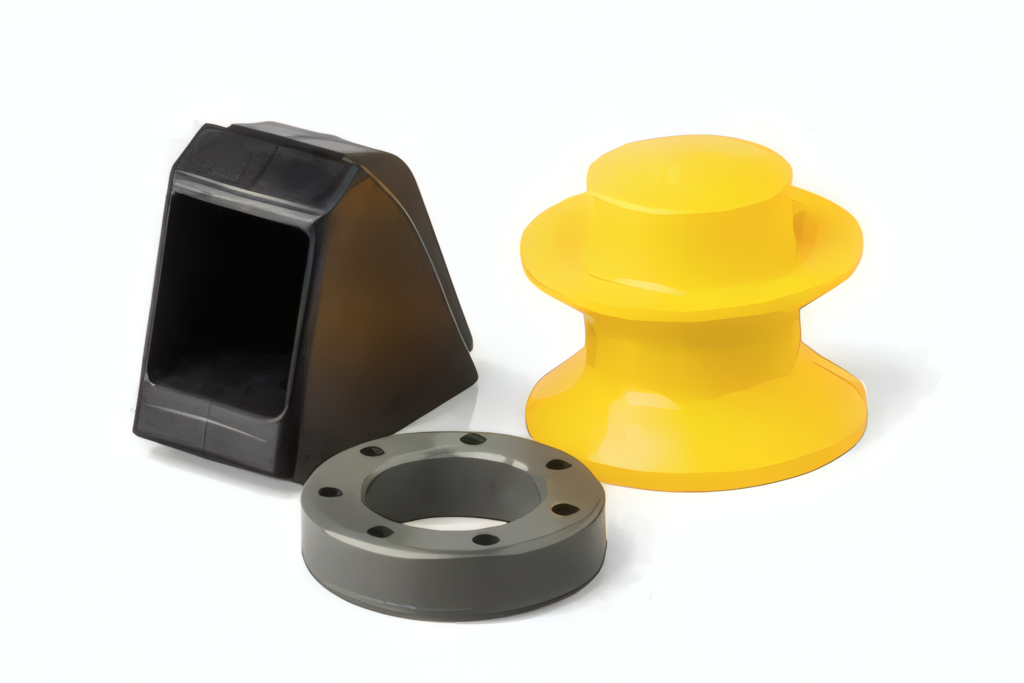
UW-ELAST injection moulds products that achieve outstanding properties. We are particularly skilled in injection moulding thermoplastic elastomer (TPE) and thermoplastic polyurethane (TPU). These materials are similar in properties to our cast materials.

We also injection mould other types of plastics, such as PA (nylon), POM, ABS, etc.

Injection moulding of TPE and TPU, as well as other thermoplastics, involves melting a solid raw material and then injecting it into a mould under high pressure in a short time.

With injection moulding, we can manufacture small to medium-sized parts with high requirements for material properties, produced in very long series. We also offer solutions for metal replacement. UW-ELAST AB currently offers injection moulding at our production facility in Traryd. At present, there are four injection moulding machines with 35 to 120 tonnes of clamping force.

Examples of injection-moulded products include toe caps, plastic components, etc.

About TPU

TPU is a urethane-based thermoplastic suitable for injection moulding, offering a range of outstanding properties thanks to the combination of high abrasion resistance (wear resistance), tear strength and elasticity. As an engineering material for, among other things, industry, TPU solves the most complex problems while also being highly cost-effective. We currently injection mould TPU grades from 40 Shore A to 75 Shore D. Injection moulding with TPU differs significantly from injection moulding with other thermoplastics. We work with both ether- and ester-based materials.

Extreme deformation of a TPU part. Thermoplastic polyurethane today has deformation properties very close to hot-cast polyurethane. This part was originally manufactured in hot-cast polyurethane and is now produced in TPU. The test was carried out at room temperature and at -35°C.

Plastic injection moulding

We can also use other plastic materials for injection moulding, such as Polyoxymethylene (POM), Polyamide (PA), Polycarbonate (PC), ABS and Polypropylene (PP).

Polyoxymethylene (POM), also known as acetal, polyacetal, and polyformaldehyde, is a thermoplastic used to manufacture parts that require stiffness, low friction and tight dimensional tolerances. The parts have good strength and high heat resistance. The material is easy to machine to the correct dimensions by turning, milling and grinding. Used for gears, bearings, snap locks (due to excellent spring properties), rollers and hinges. Approved for food handling.

Polyamide (PA) is a polymer containing amide groups. Polyamides are referred to as amide plastics. Polyamides can be crystalline or semi-crystalline thermoplastics, or amorphous thermoplastics. The parts are wear-resistant, very tough and have good sliding properties. Good resistance to oils, fats, petrol and diesel. Used for gears, screws, rims, bushings and slide rails. Often compounded with glass fibre for improved properties.

Polycarbonate (PC) is an amorphous thermoplastic that is highly transparent, has extremely high impact strength in both cold and heat, and high strength. Good electrical properties are also an advantage. Used for covers, lenses and protective glazing in various forms.

ABS plastic is a copolymer with varying amounts of Acrylonitrile, Butadiene and Styrene monomers, which explains the name. The material has good impact strength, surface hardness and surface finish. ABS is resistant to acids, alkaline solutions, alcohol, grease, oil and salt solutions. Used for kitchen utensils and plastic housings.

Polypropylene (PP) is one of the most common thermoplastics. The plastic is made up of propene and is sometimes referred to as polypropene. Polypropylene has a low density, high strength, good chemical resistance, good sliding properties and high temperature resistance. It is used, among other things, in food packaging, toys, car parts, pump components, instrument panels, pipes and pipe fittings.

When should injection moulding be chosen?

There are some differences between casting and injection moulding when it comes to the material. In casting, a thermoset is used—a polyurethane that becomes tough and durable through cross-linking. In injection moulding, we primarily use thermoplastic polyurethane, which is not cross-linked. There are no multiple components or curing process involved. Instead, injection moulding takes place when the polyurethane is molten, and the product then solidifies as the polyurethane cools. The thermoplastic can be recycled and remelted, whereas thermosets cannot be recycled in this way.

The transition from, for example, thermoset casting to thermoplastic injection moulding often occurs as a natural step when production volumes increase. The material change may result in some loss of material properties, but the manufacturing cost decreases significantly.

Thanks to our experience and our commitment to always deliver both at the best price and with optimal lead times, we know when it is appropriate to propose injection moulding as an alternative. In general, the method is best suited to smaller parts in long series, which for us means 1,000 parts or more.

Please do not hesitate to contact us if you have any questions about injection moulding.