
How do we calculate our climate compensation?

UW-ELAST has chosen to follow the calculation method recommended in the Greenhouse Gas Protocol, developed by WRI (World Resources Institute) and WBCSD (World Business Council for Sustainable Development).

The standard was developed, among other things, with the aim of:

  • Helping companies calculate their greenhouse gas emissions in a true and fair manner by using standardized calculation methods
  • Making it easier for companies to carry out their emissions inventory
  • Providing companies with information that can be used to strategically reduce greenhouse gas emissions
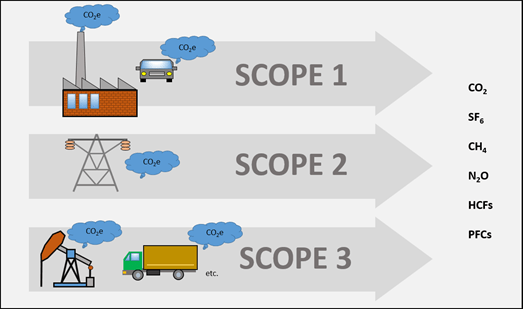
A company’s climate impact is divided into 3 different scopes

Scope 1: Direct greenhouse gas emissions from operations

The system boundary is set here around the direct operations (the owned production units), and emissions from stationary and mobile sources as well as process emissions are examined. Consideration is also given to unintended emissions, such as leakage of F-gases.

Scope 2: Greenhouse gas emissions resulting from electricity consumption

In Scope 2, consideration is also given to the emissions that occur at the source that generates the electricity consumed by the operations. These emissions may therefore occur geographically far from the operations.

Scope 3: Indirect greenhouse gas emissions outside the operations

Scope 3 has no strict definitions of what should be included in the climate impact, but it also takes into account indirect emissions that, for example, occur at the company’s suppliers and through transport to and from the operations, i.e., emissions that occur outside the company’s ownership and control.

The ambition here is to capture the entire overall impact that the operations have on the climate.

It is not uncommon for the largest greenhouse gas emissions to occur outside the operations.

Download...

Greenhouse gas emissions are calculated as the total climate impact of the 6 greenhouse gases mentioned in the Kyoto Protocol – carbon dioxide CO2, methane CH4, nitrous oxide N2O, hydrofluorocarbons HFCs, perfluorocarbons PFCs, sulfur hexafluoride SF6. These gases are converted into their corresponding carbon dioxide equivalents and then summed. In this way, we can obtain an overall picture of the operations’ climate impact.

With 2018 as the reference year, we can see that our efforts are delivering clear and positive results. Between 2018 and 2021, we reduced our total climate footprint to 75%.

A summary of UW-ELAST’s total climate impact from 2018 to 2025 is shown here.